Following a fish toward Mangwon Market

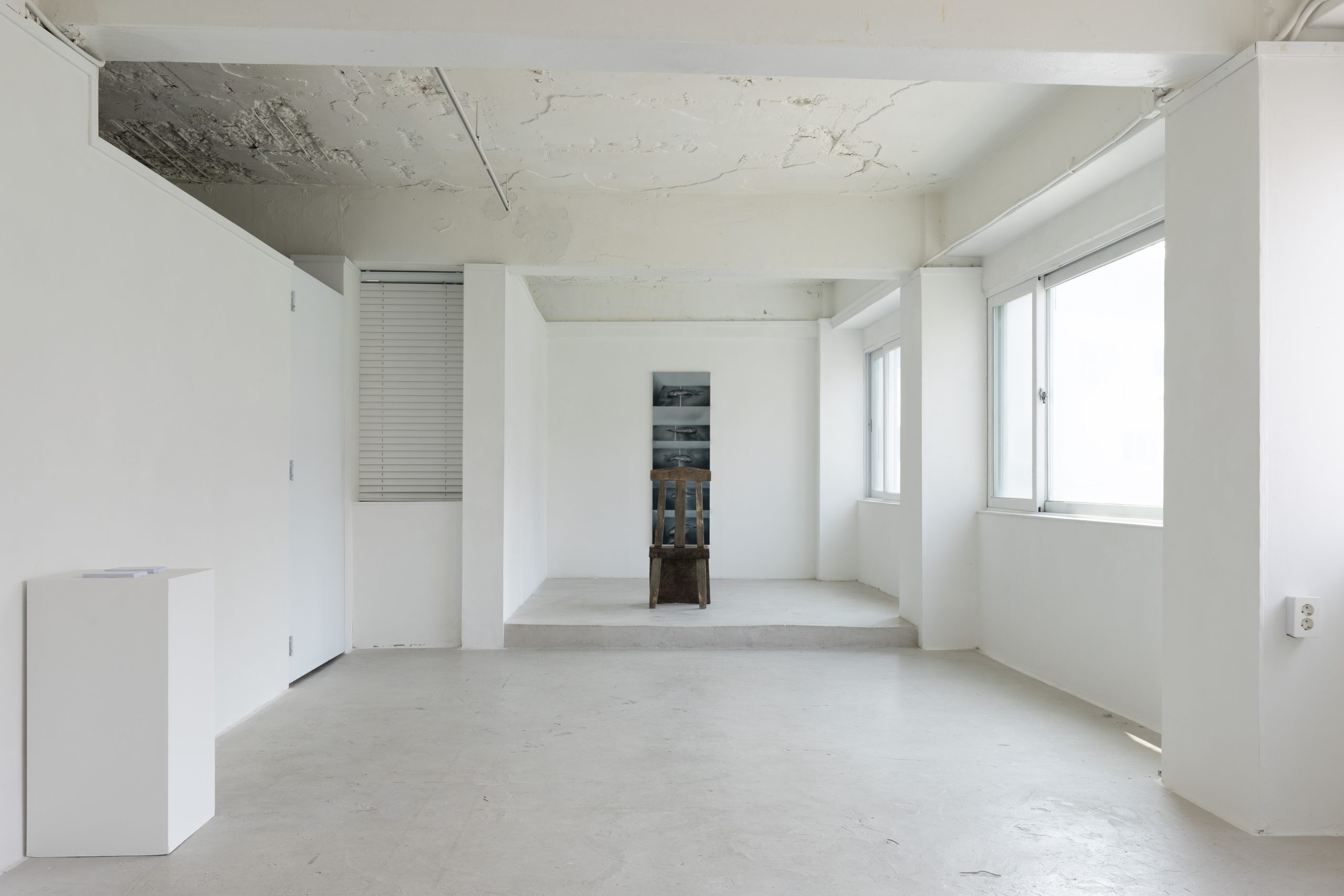
Wide view of Fish I–V arranged vertically in a white gallery, with a wooden sculptural object in the foreground.

In Fish, by Kim Myungchan, a leg begins to bounce. From that small, restless movement, Fish sets off toward Mangwon Market, where a speaker passes the stalls with a noisy mind and the simple intention of drawing a fish. The short text supplied with the work moves like a note taken on the way: quick steps, glances into shops, a vendor’s question, and an answer that changes the encounter.

A distant view of the gallery sets the paintings at the end of a bright, spare room.
From the side, the stacked paintings appear beside a small wooden sculptural form.

“Would you like it salted?” the vendor asks. “Please leave it as it is,” comes the reply. The exchange is practical, almost incidental, yet it gives the text its hinge. The fish first appears as something to look for and depict; by the final line, it has turned around and is pursuing the narrator. The shift is funny and slightly uncanny, making an everyday errand feel like the opening of a chase.

That reversal finds a visual counterpart in Fish I–V, a five-part group of paintings arranged vertically. The installation places the images in a top-to-bottom sequence, so looking becomes a paced act: the eye travels down the column as if following a thought that cannot quite settle. In the wider room views, a small wooden form sits nearby, its quiet presence adding a human scale without resolving the fish’s ambiguous role.

A front-facing installation view pairs the vertical fish sequence with a wooden sculptural object.
The wooden form stands apart from the paintings, giving the otherwise spare installation a human scale.
Five dark paintings form a narrow column, echoing the handout’s top-to-bottom listing of Fish I–V.

Each painting holds a fish within a subdued, darkened field. Soft edges and veiled tones keep the animal from reading as a sharply outlined specimen. Instead, it seems to surface and recede at once, suspended between recognition and blur. The modest horizontal format gives the fish room to move across the image, while the stacked installation turns five separate views into a single, measured passage.

A fish appears within a dark, softened field of water in this closer view.
Viewed at an angle, the adjacent panels make the five-part sequence feel like a measured progression.

The material supports this restrained presentation. The handout identifies the works as acrylic on aluminum plates, mounted on aluminum profiles, and lists a size of 33 × 55 cm. Seen obliquely, the mounting lets the panels sit slightly away from the wall; that small interval gives the sequence a physical edge while keeping attention on the painted surface. The installation’s crisp structure and the images’ indistinct water remain in productive tension.

An oblique angle reveals the shallow spacing created by the aluminum-profile mounts.
One image isolates the fish in a muted underwater haze.
A pale fish crosses a dark field, interrupted by a fine vertical reflection.
A close view brings the fish’s head and body out of the softly blurred water.

The accompanying text does not explain what the fish means, and the paintings do not settle the question either. Their connection lies in a change of position: the person who intends to look becomes the one being watched—or followed. By setting five quiet images beside a brief, unsettled narrative, Fish lets that reversal gather gradually, until the ordinary act of walking through a market feels less like observation than an encounter.

One of Fish I–V hangs alone, its horizontal image surrounded by open white wall.
A lone fish moves across the painting’s subdued, gray-toned water.
The isolated fish is set against a quiet field that leaves much of the image unresolved.

Rather than repeating the same image, the individual views offer small differences in distance and emphasis. A fish may cross a pale stretch of water; elsewhere, its form is partly absorbed by the surrounding haze. Together, these variations keep the series open-ended. Like the narrator’s walk, the paintings move between attention and distraction, inviting a second look without giving the viewer a final answer.

This wall view emphasizes the painting’s broad horizontal format and spare presentation.
The final individual view gives the fish room to drift within a muted aquatic landscape.

Artist: Kim Myungchan / @kim.myungchan
Subscribe to Sketchure

A periodic digest of new stories on art, design, architecture and craft.

Don't Miss

At Leeum, Koo Jeong A gives visitors the right to miss things

Koo Jeong A’s largest Korean solo show spreads through Leeum Museum of

Stems, nodes and blank documents at Kukje Gallery

Kukje Gallery opens Heejoon Lee’s Stems and Nodes and Jenny Holzer’s BLANK,