Damien Hirst has spent nearly four decades putting death on display and putting a price on it. He organised the student show that Tate treats as the starting point of the Young British Artists, sold a shark that became shorthand for what contemporary art can cost, and in 2026 drew 541,889 visitors to his first large solo exhibition in Asia, at the National Museum of Modern and Contemporary Art in Seoul.
His work keeps returning to plain questions. What does death look like when it is kept behind glass? Who decides what an object is worth? How much of an artwork lives in the thing itself, and how much in what people agree to believe about it? This essay follows those questions through the works and the deals, keeping to the record and saying clearly where the reading is our own.
Damien Hirst in Leeds and at Goldsmiths
Hirst was born in Bristol in 1965, grew up in Leeds and moved to London in 1984. He has said: “I was brought up Catholic, and I felt the power of art from a very young age”.
At sixteen he went with a friend who was studying microbiology to a morgue in Leeds, where he was photographed beside a severed head; the picture became the work With Dead Head. Around the same time, according to the National Galleries of Scotland, he began collecting pathology books with pictures of burns and wounds and took an interest in Francis Bacon.
The drink and drugs, by contrast, came later. A 2004 profile in The Telegraph describes “the binges that followed his sudden rise to fame” and reports that he cleaned up around 2002, giving up cigarettes and, with them, drink. The same piece records his words on the death of his friend Joe Strummer: “It was the first time I felt mortal”.
He studied at Goldsmiths from 1986 to 1989, where, according to HENI, he started two series he still makes: the spot paintings and the medicine cabinets. Marcel Duchamp and Donald Judd are usually listed among his influences. Our reading is that his best-known works sit where those two lines cross: a real thing taken out of its use, and a clean geometric case that keeps it at a distance.
A shark behind glass
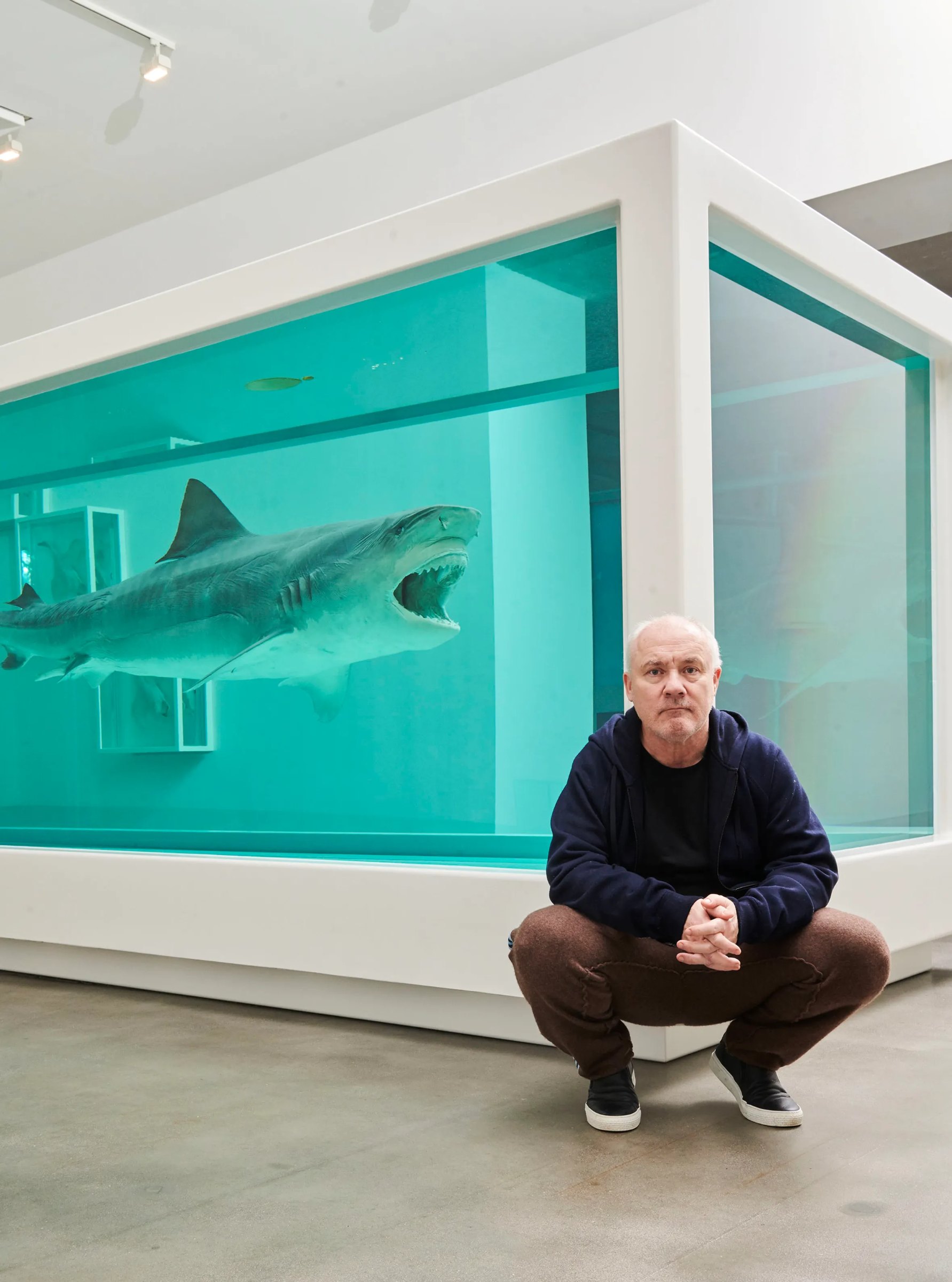
In 1991 Charles Saatchi paid Hirst £50,000 for The Physical Impossibility of Death in the Mind of Someone Living; Hirst had spent £6,000 obtaining the shark from Australia. The tiger shark, a 14-footer caught by a fisherman in Australia at Hirst’s request, hung in formaldehyde, and Saatchi first showed it at the Saatchi Gallery in London the following year.
In fact, the title does the work a caption would normally do. The animal is a predator and a corpse at once, near enough to touch and sealed off. What frightens is not the shark but the idea that it might still move. In our view this is Hirst’s most precise piece: the glass protects the viewer and also reminds them that they need protecting.

The critics
However, not everyone saw it that way. Robert Hughes, writing in The Guardian in September 2008, called it “his far-famed shark with its pretentious title” and “‘nature’ for those who have no conception of nature”. It “might have had a little more point if Hirst had caught it himself”, he added, since the job had been done by a professional fisherman and paid for by Saatchi.
Meanwhile, the first shark did not keep. “The last shark was never injected, so it decayed from the inside,” Hirst told The New York Times in 2006, while his team prepared a 13-foot replacement in Gloucestershire. The replacement raised a question conceptual art has never settled: is the work the particular animal, or the instruction to put a shark in a tank? Hirst’s practice suggests he believes the second.
Saatchi, Cohen and the price of a shark
Meanwhile, the shark’s later life shows how value moves. In January 2005 The Observer reported that Saatchi had sold it to an American collector for nearly £7 million; its owner was the hedge fund manager Steven A. Cohen. A work bought for £50,000 had multiplied in price many times over in thirteen years without any change to the object.
By then, however, Hirst and Saatchi had fallen out. In November 2003 The Guardian reported that Hirst had bought back 12 early works from the collector through his dealer Jay Jopling, for an undisclosed sum, ending a “simmering feud”. Saatchi kept several of the best-known pieces, among them the shark, the cows and the sheep. Our reading is that the buyback shows an artist who understood early that the market for his work was something he could act on, not only something that acted on him.

A skull made of money
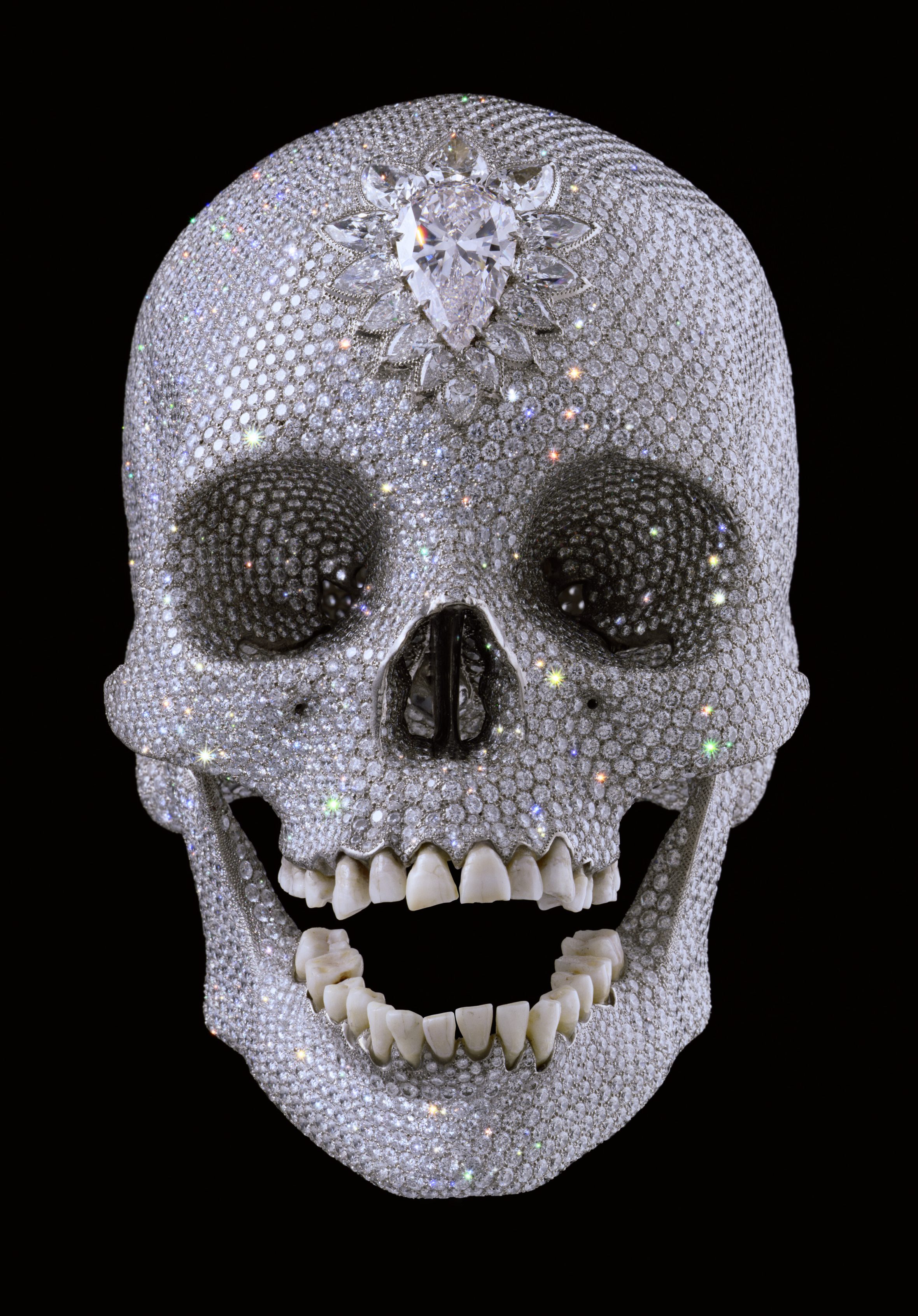
For the Love of God, unveiled at White Cube in June 2007, is a life-size platinum cast of a human skull covered with 8,601 flawless pavé diamonds weighing 1,106.18 carats. Richard Dorment wrote in The Telegraph that the asking price of £50 million was “crucial to the work’s meaning”.
The vanitas tradition used a painted skull to remind the viewer that wealth ends. Hirst reversed the order and covered the reminder in wealth. Whether that is a critique or a celebration is the argument the piece was built to start.
Vulgar or honest?
As a result, the responses split along that line. Dorment himself wrote that “if anyone but Hirst had made this curious object, we would be struck by its vulgarity”. Ralph Rugoff, director of the Hayward Gallery, said in 2008: “It’s not challenging or fresh. It’s a decorative object which is not particularly well done”. Hughes found it “a letdown unless you believe the unverifiable claims about its cash value”. Germaine Greer, defending Hirst, read his whole enterprise as “a Vanitas, a reminder of futility and entropy”.
In the end, the sale became part of the work. White Cube announced in August 2007 that the skull had been sold to a group of investors. In 2022 Hirst told The New York Times that he still owned it in partnership with White Cube and unnamed investors, and that it sat in storage in Hatton Garden, as Artnet News reported. In our reading, that is where the piece is most honest: it shows that a price can be produced, not only received.
Pills, spots and other people’s hands
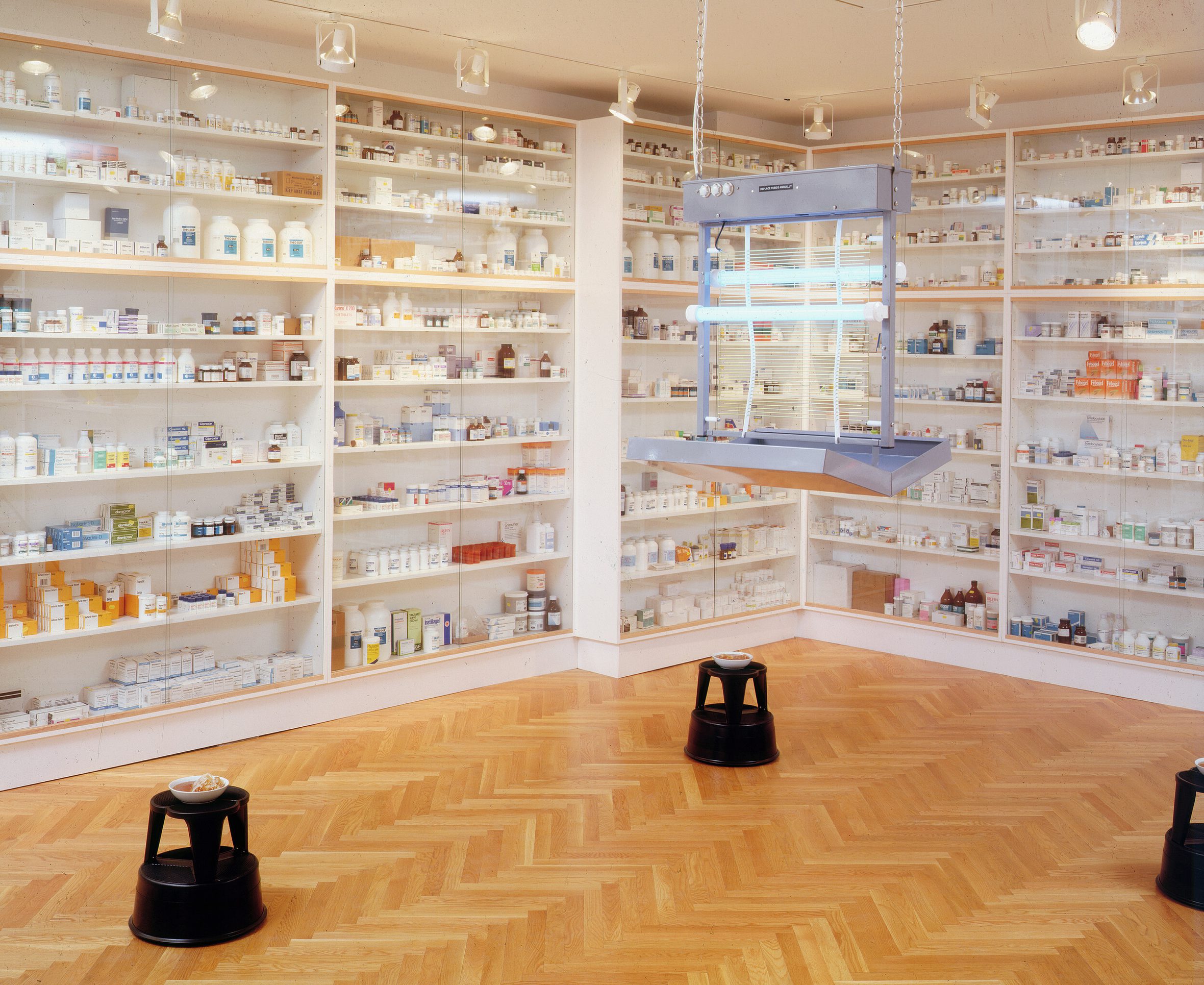
The medicine cabinets began at Goldsmiths, which HENI describes as “an early investigation into science, medicine and systems of belief and trust”. In 1992 they grew into Pharmacy, a room-sized installation now in the Tate collection. Rows of packaged drugs stand where a believer might expect relics. We read them as altars for a secular age: the faith that once went to saints now goes to the dispensary, and the cabinet looks most reassuring precisely where it can do least.
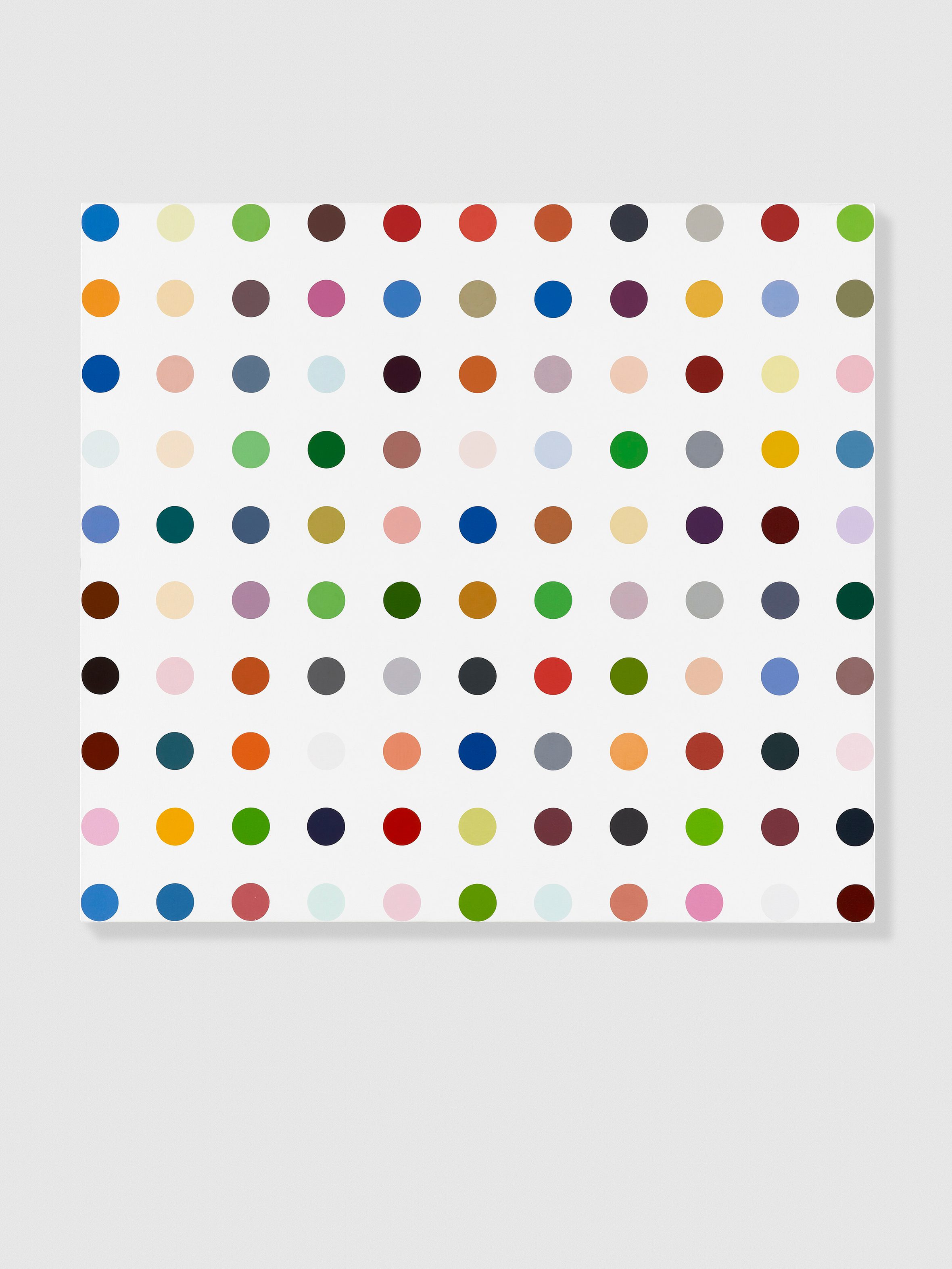
The spot paintings, by contrast, made a point about authorship. Greer, writing in his defence in 2008, noted that Hirst does not paint them himself and that “the best spot paintings by Damien Hirst are those painted by Rachel Howard”, his former assistant. This is the oldest argument in conceptual art, run at studio scale. The individual hand, long the guarantee of an artwork’s worth, is replaced by a rule that anyone in the studio can follow. To call the studio a factory is simply accurate. The real disagreement is whether a factory can make art.
Hymn and the question of borrowing
Hymn is a 20ft bronze that enlarges the Young Scientist Anatomy Set, a £14.99 toy made by Humbrol and designed by Norman Emms; Saatchi bought it in 2000 for £1 million. That May, The Guardian reported that Hirst had agreed to pay an undisclosed sum to head off a copyright claim: a “goodwill payment” to Emms, contributions to the charities Children Nationwide and the Toy Trust, and restrictions on future reproductions.

Still, the charge of borrowing did not end there. In September 2010 The Guardian reported that the artist Charles Thomson, a co-founder of the Stuckists, had compiled 15 claims that Hirst’s works were “inspired” by others, eight of them new, for Jackdaw magazine; the list took in the medicine cabinets, the spot and spin paintings and the anatomical figure. In 2017 parts of his Venice exhibition drew accusations of cultural appropriation.
Here, then, we take a position. Since Duchamp, artists have treated existing objects and images as raw material, and Hymn does change its source: a classroom toy, scaled to the size of a monument and cast in bronze, stops being playful and becomes a statue of the body’s fragility. The stronger objection is about scale and power. When an artist with Hirst’s budget, reach and prices takes up an idea, the earlier and smaller version tends to disappear behind his. The question his critics raise is less “did he borrow?” than “who gets remembered when he does?”
How Damien Hirst went around the gatekeepers
Hirst’s habit of building his own route started at art school. In 1988, while still a student at Goldsmiths, he organised Freeze, with fellow students including Sarah Lucas, Angus Fairhurst and Michael Landy; Tate treats it as the starting point of the Young British Artists.
Twenty years later, he did the same with the market. On 15 and 16 September 2008, Sotheby’s in London offered Beautiful Inside My Head Forever: 223 new works sent straight from the studio, bypassing his dealers. The first evening raised £70.5 million, and The Golden Calf, a bullock in formaldehyde with hooves and horns cast in 18-carat gold, set a Hirst record at £10.3 million. The sale made £111 million in all, “just as the global financial crisis began”.

Who was bidding?
Soon, questions followed. Prospect noted that Jopling, Hirst’s London dealer, bought the first lot for £993,250 and bid on 20 of the 56 lots that evening, adding that one could not know whether he was bidding for a client or supporting his artist’s prices. Greer saw the event differently. Answering Hughes in The Guardian, she wrote: “Bob dear, the Sotheby’s auction was the work,” and called the strength of Hirst’s brand “revolutionary even”. Her line is the one we find most useful. If the auction was the work, its subject was the market, and the market answered just as the financial crisis broke.
Fictions, tokens and dates
In 2017 Hirst filled Palazzo Grassi and Punta della Dogana in Venice with Treasures from the Wreck of the Unbelievable: more than 200 new works presented as the cargo of an ancient ship, encrusted with shells and coral. Of course, the shipwreck was invented. The show staged the museum’s own tools of trust, the excavation photograph, the restored fragment, the label, around objects with no past at all.


Once again, critics split. Jonathan Jones in The Guardian found Hirst’s imagination “audaciously and beautifully reborn”. Jan Dalley in the Financial Times asked whether it was “a fantasy too far”. Rachel Campbell-Johnston in The Times called it absurd: “It should be dumped at the bottom of the sea”.
The Currency
The Currency moved the same question onto the blockchain. It paired 10,000 dot paintings on paper with 10,000 NFTs, each first sold for $2,000, and asked buyers to keep one or the other. 5,149 chose the paper work; 4,851 kept the token, and their paintings were burned at Newport Street Gallery in London in October 2022. Hirst said the value “will not be lost it will be transferred to the nft”. HENI, which released the project, describes it as forcing collectors “to put faith in where they see value”.

Dates and doubts
However, that faith met a harder test in 2024. In March, The Guardian reported that three formaldehyde works, made with a dove, a shark and two calves and dated by his company to the 1990s, had been made in 2017. In May it reported that at least 1,000 of the Currency paintings marked 2016 had been painted years later; lawyers for Hirst and his company Science did not dispute this, and said it was his “usual practice” to date works in a conceptual project by the year of its conception. For an artist who has always said the idea is the work, the defence is consistent. For collectors who read a date as a fact about the object, it raises real questions, and it is the clearest case of the tension this essay is about.
Seoul, 2026
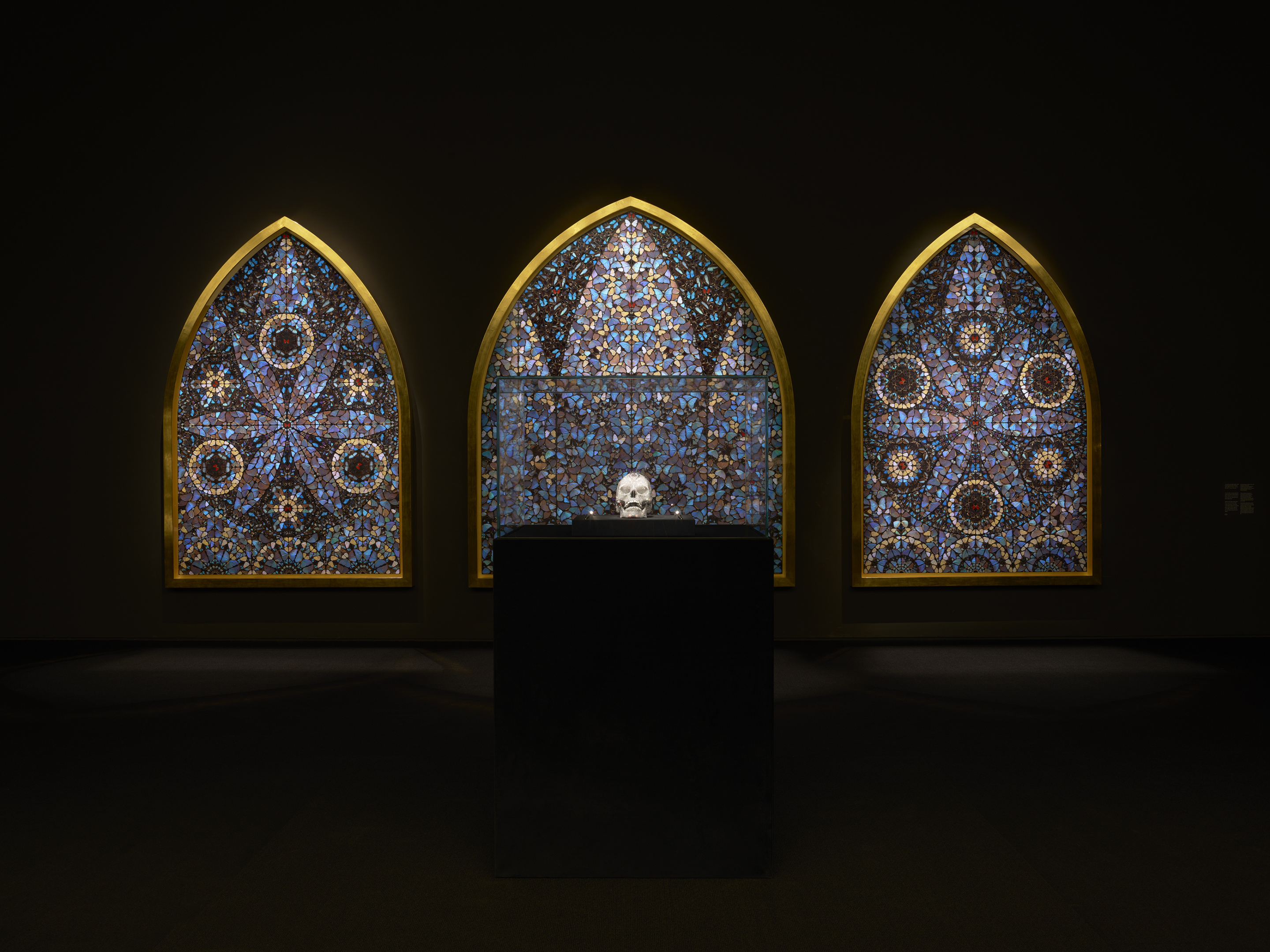
From 20 March to 28 June 2026, the National Museum of Modern and Contemporary Art in Seoul showed Damien Hirst: Nothing Is True But Everything Is Possible, described as his first large-scale solo show in Asia. More than 50 works spanned his career, from the Natural History series and medicine cabinets to the spot, spin, butterfly and Cherry Blossom paintings. The shark, on loan from a New York collector, appeared in Korea for the first time, and a senior MMCA curator said: “We expect a lot of debate, and we welcome it”. The exhibition drew 541,889 visitors. In September the museum announced that Hirst intends to donate two works shown there, Beautiful Exploding Hell Bent Mayhem and Madness Vortex of Rainbows and Death Volcano Painting (1999) and Men Shall Know Nothing (2008).

What remains
In short, what Hirst changed is easier to state than whether it was good. He showed that an artist can act on the market directly; the Sotheby’s sale, the buyback from Saatchi and his stake in the skull all point the same way. He widened what counts as an art material, from formaldehyde and pharmaceuticals to diamonds and tokens on a blockchain. And he made the price of a work part of its subject, so that discussing one means discussing the other.
Even so, we do not think his work sets out to console. At its best it puts a viewer in front of two things modern life prefers to keep out of sight, the body after death and the mechanics of value, and refuses to let either look natural. At its weakest it confirms the suspicion that the second has swallowed the first. Both readings are in the work, and that double edge is why the arguments around Hirst have not ended.
Artist: Damien Hirst / @damienhirst
Photography: Prudence Cuming Associates Ltd; Brooklyn Museum; Garry Knight; NearEMPTiness; Sailko. Images courtesy White Cube, Tate and HENI as credited.
Sources
- Akbar, Arifa. “A formaldehyde frenzy as buyers snap up Hirst works”. The Independent, 16 September 2008.
- Akbar, Arifa. “Hirst’s £50m skull? It’s no more than a “decorative object””. The Independent, 8 March 2008.
- Alberge, Dalya. “Damien Hirst faces eight new claims of plagiarism”. The Guardian, 2 September 2010.
- Artnet News. “Turns out the diamond skull that Damien Hirst and White Cube said they sold for $100 million in 2007 still belongs to them”. Artnet News, 26 January 2022.
- Artprice. “Damien Hirst in Seoul, South Korea: a striking retrospective at the MMCA in 2026”. Artprice, 27 March 2026.
- Artsy Editorial. “Damien Hirst show sparks accusations of cultural appropriation”. Artsy, 12 May 2017.
- Dorment, Richard. “For the love of art and money”. The Telegraph, 1 June 2007.
- Dyer, Clare. “Hirst pays up for Hymn that wasn’t his”. The Guardian, 19 May 2000.
- Gibbons, Fiachra. “Hirst buys his art back from Saatchi”. The Guardian, 27 November 2003.
- Greer, Germaine. “Note to Robert Hughes: Bob, dear, Damien Hirst is just one of many artists you don’t get”. The Guardian, 22 September 2008.
- HENI. “Damien Hirst: biography”. HENI, accessed 1 November 2026.
- HENI. “The Currency”. HENI, accessed 1 November 2026.
- Hughes, Robert. “Day of the dead”. The Guardian, 13 September 2008.
- Jardine, Cassandra. ““I knew it was time to clean up my act””. The Telegraph, 26 July 2004.
- McClenaghan, Maeve. “Damien Hirst formaldehyde animal works dated to 1990s were made in 2017”. The Guardian, 19 March 2024.
- McClenaghan, Maeve. “At least 1,000 Damien Hirst artworks were painted years later than claimed”. The Guardian, 22 May 2024.
- National Galleries of Scotland. “Damien Hirst, With Dead Head”. National Galleries of Scotland, accessed 1 November 2026.
- NPR. “Damien Hirst just burned 1,000 of his paintings and will soon burn thousands more”. NPR, 12 October 2022.
- Prospect. “Hirst’s unburstable bubble”. Prospect, October 2008.
- Smith, David. “Hirst shark sold for £7m”. The Observer, 16 January 2005.
- Smith, Roberta. “Just when you thought it was safe”. The New York Times, 16 October 2007.
- Sotheby’s. “Frank Dunphy: art’s secret agent”. Sotheby’s, accessed 1 November 2026.
- Tate. “Away from the Flock, 1994”. Tate, accessed 1 November 2026.
- Tate. “Pharmacy, 1992”. Tate, accessed 1 November 2026.
- Tate. “Young British Artists (YBAs)”. Tate, accessed 1 November 2026.
- The Art Story. “Damien Hirst”. The Art Story, accessed 1 November 2026.
- The Korea Times. “Life, death and diamonds: Damien Hirst debuts first Asia solo show at MMCA Seoul”. The Korea Times, 19 March 2026.
- The Korea Times. “Damien Hirst exhibition at MMCA attracts 540,000 visitors”. The Korea Times, 29 June 2026.
- The Korea Times. “Damien Hirst to donate 2 pieces of artwork to national museum in Seoul”. The Korea Times, 9 September 2026.
- The Local. “Damien Hirst’s new show divides visitors in Venice”. The Local, 10 April 2017.
- Vogel, Carol. “Swimming with famous dead sharks”. The New York Times, 1 October 2006.
- White Cube. “Damien Hirst and MMCA”. White Cube, accessed 1 November 2026.